
Nigeria
History & Regions
From the Nok terracottas of 500 BC to independence in 1960 — and the country, region by region.
Overview
An African giant, millennia in the making.
Virtually all the native races of Africa are represented in Nigeria. It was here that the Bantu and Semi-Bantu, migrating from southern and central Africa, intermingled with the Sudanese; later waves — the Shuwa-Arabs, the Tuaregs and the Fulani — crossed the Sahara into the north.
Today more than 250 ethnic groups call Nigeria home. Four major groups — the Hausa and Fulani of the north, the Yoruba of the west and the Igbo of the east — make up some 60% of the population, alongside the Kanuri, Bini, Ibibio, Ijaw, Itsekiri, Efik, Nupe, Tiv and Jukun, among many others.
A Brief Timeline
500 BC
The Nok people inhabit central Nigeria — the oldest sculptures found in the country, in terracotta, with iron smelting already known.
9th c.
Arabic writers first note the kingdom of Kanem, east of Lake Chad — the beginning of a Kanem-Borno empire that would last a thousand years.
~1000 AD
The Hausa build powerful city-states around Kano, Zaria, Daura, Katsina and Gobir.
~1400
Benin's celebrated bronze-casting tradition flourishes; tradition holds the craft came from Ile-Ife under Oba Oguola.
15th c.
European explorers and traders arrive on the coast and begin trade with the Yoruba and Benin peoples.
1804
Usman Dan Fodio's Fulani movement challenges the Hausa states, establishing the Sokoto Caliphate.
1861
Lagos is colonised by the British.
1914
The territories are amalgamated as the Colony and Protectorate of Nigeria.
1 Oct 1960
Nigeria becomes an independent nation. The green-white-green is raised for the first time.
The Great Empires
Kingdoms before the country
Kanem-Borno
Dating to the 9th century east of Lake Chad, bolstered by trade with the Nile region and the trans-Saharan routes. After the Bulala invasion in the 14th century the empire's centre moved from Kanem to Borno — a state that endured, in one form or another, for around a thousand years.
Hausa-Fulani
From around 1000 AD the Hausa built states around Kano, Zaria, Daura, Katsina and Gobir, with Kano the most powerful in the 16th–17th centuries. In 1804 the Fulani under Usman Dan Fodio established the Caliphate with its headquarters at Sokoto.
The Yoruba States
Complex, powerful city-states, the first centred at Ile-Ife — in Yoruba tradition the centre of the universe, and the site of a unique naturalistic art uncovered in the 1930s. Oyo rose to become the most powerful West African kingdom of the 16th–17th centuries.
Benin
A major kingdom contemporaneous with Oyo, its people primarily Edo. The Oba, semi-divine, controlled a complex bureaucracy, a large army and a diversified economy. Benin's power — and its world-famous bronzes — peaked in the 16th century.
The Igbo & Delta Peoples
Many cultures deliberately did not centralise: Igbo societies organised as self-contained villages and federations governed by elders and age-grade associations — as did the Ijaw of the Niger Delta and the Cross River peoples, where secret societies were prominent. By the 18th century, overseas trade encouraged more centralised forms.
Region by Region
Five regions, one journey
South-West
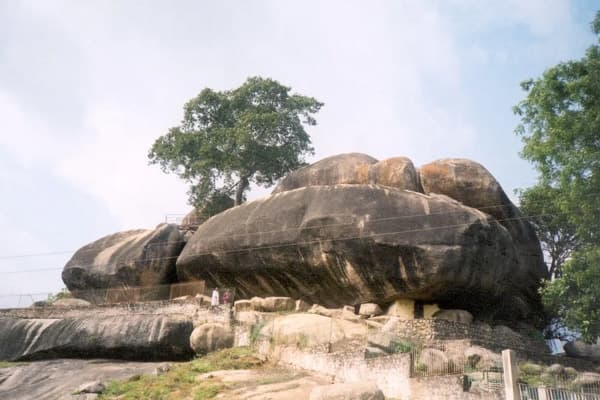
Lagos (Eko — the National Museum, National Theatre, the beaches and the Oba's Palace) · Abeokuta ("under the rock" — Olumo Rock, home of adire cloth) · Ibadan (Dugbe market, Cocoa House, the University) · Ile-Ife (cradle of creation; terracottas and bronzes of the 12th–15th centuries) · Benin City (the Benin bronzes, Chief Ogiamen's House) · Ondo (Ikogosi Warm Spring, Idanre Hills, Owo Museum).
South-East
Anambra (Ogbunike caves, Agulu Lake, the Igbo-Ukwu excavations, Onitsha market, Ofala festivals) · Calabar (National Museum in the Old Residency, 1884) · Enugu (the "coal city" — Iva Valley Coal Mine Museum) · Oron (National Museum, Ekpo carvings) · Owerri (Oguta Lake Holiday Resort) · Port Harcourt ("The Garden City") · Umuahia (National War Museum).
Central
Abuja (seat of government — Aso Hills, Zuma Rock) · Gurara Falls (Niger State — a 200 m span with a 30 m drop) · Owu Falls, Kwara (the highest waterfall in West Africa, 330 ft) · Lokoja (the confluence of the Niger and Benue) · Bida (Nupe handicrafts, glass beads, brass work) · Ilorin (the 1831 Mimi's Mosque; the Esie Museum of stone figures) · Makurdi (River Benue).
North-East
Bauchi (Yankari, the Geji rock paintings, the Tafawa Balewa memorial) · Jos (4,062 ft — National Museum, Museum of Architecture, Assop and Kura Falls, Shere Hills) · Maiduguri (Kanuri and Shuwa heartland) · the Bulatura Oases (dunes, camels and birdlife) · Yola (the upper Benue, Mambilla Plateau) · the Mandara Mountains along the Cameroon border.
North-West
Kano (the oldest major city in Sub-Saharan Africa — the Emir's Palace, Gidan Makama Museum, the Central Mosque) · Kaduna (National Museum, Durbar tradition) · Katsina (the Goborau Minaret — the tallest mud-brick building in Nigeria) · Birnin Kebbi (the Argungu Fishing Festival) · Sokoto (seat of the Sultan; Usman dan Fodio's resting place) · Zaria (one of the seven original Hausa cities; Ahmadu Bello University).